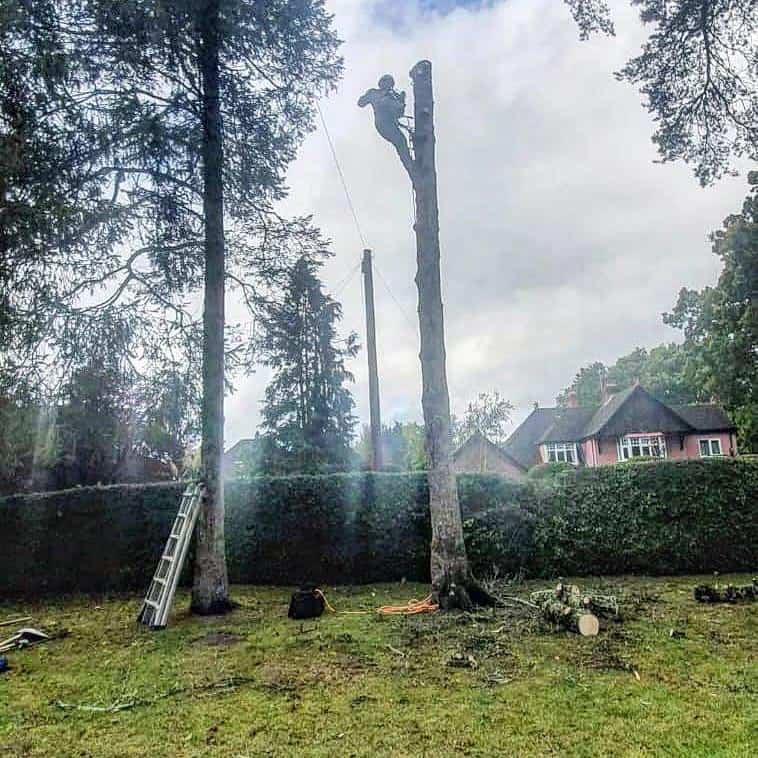
Crown reduction is a skilled tree surgery technique used to reduce the overall height, spread or volume of a tree’s crown while maintaining a natural, balanced shape. It can be particularly useful where a mature tree has become too large for its surroundings, where particular branches require management or where the crown needs to be brought into better proportion with the available space.
For property owners in Camberley, Surrey, an important question is what happens afterwards. Trees are living organisms and will continue developing after pruning, so crown reduction should not necessarily be viewed as a permanent change to the tree’s eventual size. Depending on the species, condition, location and response to pruning, further management may be appropriate in the future.
Why Crown Reduction May Need to Be Repeated Over Time
A correctly performed crown reduction removes selected growth while retaining an appropriate branch structure and natural appearance. Once the work is complete, however, the tree continues responding to its environment and producing new growth.
This does not mean crown reduction needs to be repeated according to a fixed timetable. Some trees may require further attention sooner than others, while certain trees can remain well balanced for a considerable period. Regular observation and professional assessment are more useful than assuming every tree requires the same pruning cycle.
Trees Continue Growing After Crown Reduction
Crown reduction manages existing growth; it does not stop future growth.
After pruning, the remaining branches and buds continue developing. Over time, this can gradually increase the height and spread of the crown again.
The speed at which this happens can vary considerably. Species, maturity, growing conditions, available light and the extent of the previous reduction can all influence how a tree responds.
For this reason, future work should be based on the tree’s actual development rather than automatically repeating the original reduction after a predetermined number of years.
Tree Species Can Influence Regrowth
Different tree species respond to pruning in different ways.
Some naturally produce vigorous new shoots following crown work, while others develop more slowly. Understanding these growth characteristics is an important part of deciding how much material should be removed and how the tree may need to be managed afterwards.
Excessive pruning can also encourage undesirable regrowth in certain circumstances. A carefully planned reduction is therefore preferable to removing more of the crown simply in an attempt to delay future maintenance.
Professional tree surgery aims to achieve the required reduction while retaining a suitable framework for healthy future growth.
Why the Original Reason for Crown Reduction Matters
Whether crown reduction needs repeating often depends on why the work was originally carried out.
A tree may have been reduced because its canopy had become too large for the available space, because particular branches were becoming overly extended or because the crown needed better overall balance.
If continued growth eventually recreates the same issue, further reduction may become appropriate.
However, if the tree continues growing without causing the original concern to return, repeating the work simply because a certain amount of time has passed may not be necessary.
The objective should always be to respond to the tree’s condition and surroundings.
Good Crown Reduction Should Retain a Natural Shape
Crown reduction is different from simply cutting branches back to arbitrary points.
A professional reduction involves selecting appropriate pruning points throughout the canopy so that the resulting crown remains balanced and recognisably natural. Branch structure, growth direction and the proportion of the remaining canopy all need to be considered.
This matters for future management because the way a tree is initially reduced can influence how it subsequently develops.
Well-planned pruning provides a better framework for future growth and makes it easier to assess what, if anything, needs attention as the crown develops again.
Why Repeated Heavy Pruning Is Not the Objective
If a tree requires ongoing management, the aim should not be to repeatedly remove large quantities of growth.
Heavy or poorly planned pruning can significantly alter the structure of the crown and may encourage vigorous regrowth. This can result in a cycle where substantial pruning leads to strong new growth followed by another substantial intervention.
A more considered approach is to monitor how the tree responds and undertake appropriate work when necessary.
Managing the crown carefully can help retain its shape and structure while avoiding unnecessary intervention.
Signs That a Tree May Need Another Assessment
Property owners do not need to determine for themselves whether another crown reduction is required. However, changes in the tree can indicate that professional assessment would be worthwhile.
These can include:
- The crown becoming significantly larger again
- Branches extending towards buildings or other nearby features
- Previously reduced areas producing substantial new growth
- The canopy becoming noticeably uneven
- Individual branches becoming excessively long or dominant
- The original reason for reducing the crown beginning to return
- Changes in the condition or structure of significant branches
These signs do not automatically mean another full crown reduction is necessary. An inspection can determine whether pruning is appropriate and, if so, how much work is actually required.
The Importance of Monitoring Previously Pruned Trees
A tree that has undergone crown reduction should be viewed as a tree with an ongoing growth pattern rather than a finished landscaping feature.
Observing how the canopy develops provides useful information about the tree’s response to previous work. Some sections may grow more strongly than others, and individual branches can begin changing the balance of the crown.
Periodic professional assessment can identify these developments before they become more pronounced.
This allows future tree surgery to be based on the current structure of the tree rather than simply repeating exactly what was done previously.
Future Work May Be Different From the Original Reduction
One important point is that subsequent tree surgery does not necessarily need to replicate the first crown reduction.
As the tree develops, its requirements can change. A later assessment may show that only selected areas require attention rather than the entire canopy.
For example, particular branches may have produced stronger growth, while other sections remain appropriately proportioned. In these circumstances, selective pruning may be more suitable than carrying out the same reduction across the whole crown.
This is another reason professional assessment is valuable before deciding what work should be undertaken.
Avoid Waiting Until the Crown Becomes Excessively Large Again
Where a tree genuinely requires ongoing size management, allowing it to become substantially larger before every intervention is not always the most practical approach.
Large changes in canopy size can mean more significant pruning is required when the tree is eventually attended to.
Monitoring the tree’s development makes it possible to identify when the original management objective is beginning to be lost. Appropriate intervention can then be considered while the required work remains proportionate to the tree’s current condition.
The emphasis should remain on thoughtful management rather than unnecessary frequent pruning.
Crown Reduction Should Consider the Whole Tree
The visible size of the canopy is only one consideration when assessing a previously reduced tree.
A professional tree surgeon should also consider branch structure, crown balance, previous pruning points, new growth and the general condition of the tree. The relationship between the tree and its surroundings is equally important.
A tree may have regained some of its previous size while remaining entirely suitable for its location. Conversely, a comparatively small amount of new growth in a particular direction may create a reason for attention.
Looking at the whole tree provides a much more useful basis for deciding what should happen next.
Professional Tree Surgery Supports Sensible Long-Term Management
Crown reduction is most effective when it forms part of a considered approach to tree management rather than being treated as a one-off method of permanently controlling growth.
At NS Tree Surgery Camberley, we assess trees in Camberley, Surrey according to their current size, structure, condition and surroundings. Where a previously reduced tree requires further attention, the aim is to determine what level of work is appropriate rather than automatically repeating the previous reduction.
This approach helps maintain a balanced canopy while ensuring that pruning is carried out for a clear reason.
Conclusion
Crown reduction may need to be repeated as a tree continues growing, but there is no single schedule that is suitable for every tree. Species, growth rate, previous pruning, location and the original reason for reducing the crown can all influence when further attention becomes appropriate.
The most effective approach is to monitor how the tree develops and arrange an assessment when the canopy begins losing the balance, size or clearance achieved through the previous work. Future pruning can then be tailored to the tree’s current requirements rather than automatically repeating the original reduction.
If you have a previously reduced tree in Camberley, Surrey and are unsure whether it requires further attention, contact NS Tree Surgery Camberley. We can assess its current growth and structure and recommend suitable tree surgery based on what the tree genuinely needs.
Call us on: 01276 535 693
Click here to find out more about NS Tree Surgery Camberley
Click here to complete our contact form and see how we can help with your tree needs.