Tree cutting and tree pruning are often treated as interchangeable terms, but they do not always describe the same type of work. Both involve removing branches or sections of growth, yet the purpose, extent and method can differ considerably.
Understanding this distinction helps property owners request the right service and avoid unnecessary work. For gardens in Camberley, Surrey, a professional assessment can determine whether a tree needs selective pruning, more substantial cutting or another form of tree surgery.
Understanding Tree Cutting and Professional Pruning
Tree cutting is a broad description that can cover many different tasks, from shortening obstructive branches to removing a tree in sections. Pruning is a more specific process in which selected branches are removed to achieve a defined result while retaining the tree’s overall structure.
What Is Tree Cutting?
Tree cutting generally refers to the removal of branches, limbs or larger sections of a tree. The term may be used when the main objective is practical clearance rather than detailed canopy management.
Examples can include:
- Removing branches that obstruct a path or driveway
- Cutting back growth from roofs or garden structures
- Removing a broken or hanging limb
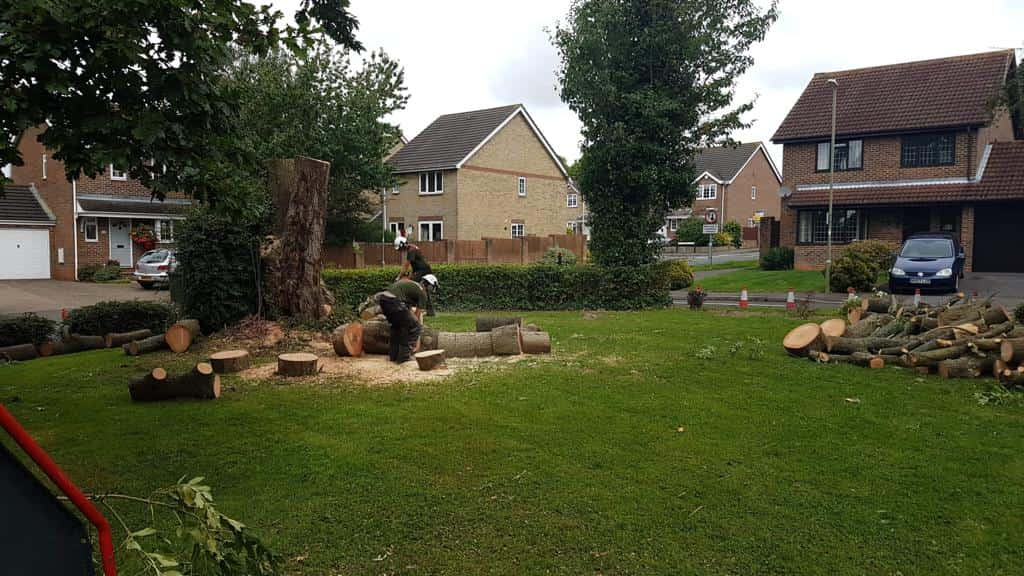
- Dismantling part of a tree in a confined space
- Cutting down a tree when retention is no longer practical
The method should still consider the tree’s condition and how the remaining structure will respond. Cutting branches without a clear plan can leave large wounds, an uneven canopy or weak regrowth.
What Is Tree Pruning?
Pruning is the selective removal of particular branches or shoots. Each cut should contribute to a specific objective, such as improving clearance, removing deadwood or managing the tree’s shape.
Professional pruning takes account of branch position, attachment, diameter and the tree’s natural form. The aim is not simply to remove growth but to leave the remaining canopy balanced and capable of developing appropriately.
The Main Difference Is the Purpose
Tree cutting may focus on removing a particular obstruction or section of growth. Pruning considers how individual cuts affect the tree as a whole.
For example, a branch extending across a driveway might need to be shortened for clearance. A pruning approach would identify a suitable growth point and assess whether shortening that branch could unbalance the surrounding canopy. This produces a more considered result than cutting it at an arbitrary position.
When Is General Tree Cutting Appropriate?
More substantial cutting may be required when a tree contains a large damaged limb, has grown into a restricted area or needs to be dismantled. It may also form part of emergency work where unstable material presents an immediate concern.
In these situations, the work must be carefully controlled. Large sections may need to be removed progressively, particularly when buildings, fences or planting occupy the space below.
When Is Pruning the Better Option?
Pruning is commonly suitable when the tree can be retained but needs targeted management. It may be used to:
- Remove dead, damaged or crossing branches
- Improve clearance from nearby features
- Manage low growth over paths
- Reduce the length of selected limbs
- Improve the balance of an uneven canopy
- Remove weak or poorly attached shoots
- Maintain the tree’s natural outline
The appropriate method depends on the tree’s species, age, condition and position within the garden.
Pruning Is Not the Same as Topping
Topping involves cutting major branches back to unsuitable points, often leaving stubs and removing a large proportion of the canopy. This can damage the tree’s natural structure and encourage dense, weakly attached regrowth.
Professional pruning uses carefully selected cuts and retains an appropriate amount of live canopy. Where overall size needs to be reduced, crown reduction should follow the tree’s existing branch structure rather than leaving a flat or severely cut outline.
Different Pruning Methods Produce Different Results
Pruning is not a single standard procedure. A tree surgeon may recommend:
- Crown lifting to increase clearance beneath lower branches
- Crown reduction to decrease the height or spread of the canopy
- Crown thinning to remove selected internal growth without significantly changing the overall size
- Deadwood removal to clear dead or unstable branches
- Formative pruning to guide the structure of a younger tree
- Selective branch reduction to manage one overextended limb
Using the correct terminology helps ensure that the work is matched to the actual problem.
Why Timing and Tree Condition Matter
Trees respond differently to cutting according to their species, age, health and stage of growth. Some tolerate particular pruning methods better than others, while stressed or declining trees may have a limited capacity to recover from substantial branch removal.
A professional assessment considers these factors before work begins. This helps determine how much growth can reasonably be removed and whether the desired result should be achieved in one visit or through gradual management.
How Poor Cutting Can Create Further Problems
Unplanned cutting may leave the canopy unbalanced, expose large wounds or stimulate vigorous shoots around the cut points. Removing too much foliage can also reduce the tree’s ability to support itself through normal growth.
Poorly positioned cuts may decay unnecessarily or fail to resolve the original issue. A branch cut back for clearance, for instance, may produce dense regrowth that quickly occupies the same space again.
What Should a Professional Assessment Consider?
Before recommending cutting or pruning, a tree surgeon should examine:
- The reason the work is required
- The tree’s species and condition
- The size and position of the branches involved
- The balance of the complete canopy
- Clearance from buildings and access routes
- The space available for controlled branch removal
- How the tree is likely to respond afterwards
This assessment allows the work to solve the practical problem while avoiding unnecessary removal.
Conclusion
Tree cutting is a broad term covering the removal of branches or larger sections, while pruning is a selective process intended to achieve a defined outcome and preserve a balanced structure. The right choice depends on the tree’s condition, position and the reason work is needed.
If you are unsure whether your tree requires cutting, pruning or more extensive tree surgery, NS Tree Surgery Camberley can assess it and recommend a suitable approach. Contact our team in Camberley, Surrey, to arrange professional tree care tailored to your garden.
Call us on: 01276 535 693
Click here to find out more about NS Tree Surgery Camberley
Click here to complete our contact form and see how we can help with your trees needs